Reliable Data. Real-Time Collaboration.
Traditional client-server architectures struggle with high-latency environments and unstable connections. They require complex conflict resolution logic and often lead to data loss or user frustration with "Loading..." indicators.
GanttSync provides a robust, offline-first synchronization layer designed for enterprise-grade applications. It ensures data consistency across distributed clients using proven synchronization primitives.
Core Synchronization Engine
⏳ Causality-Based Ordering
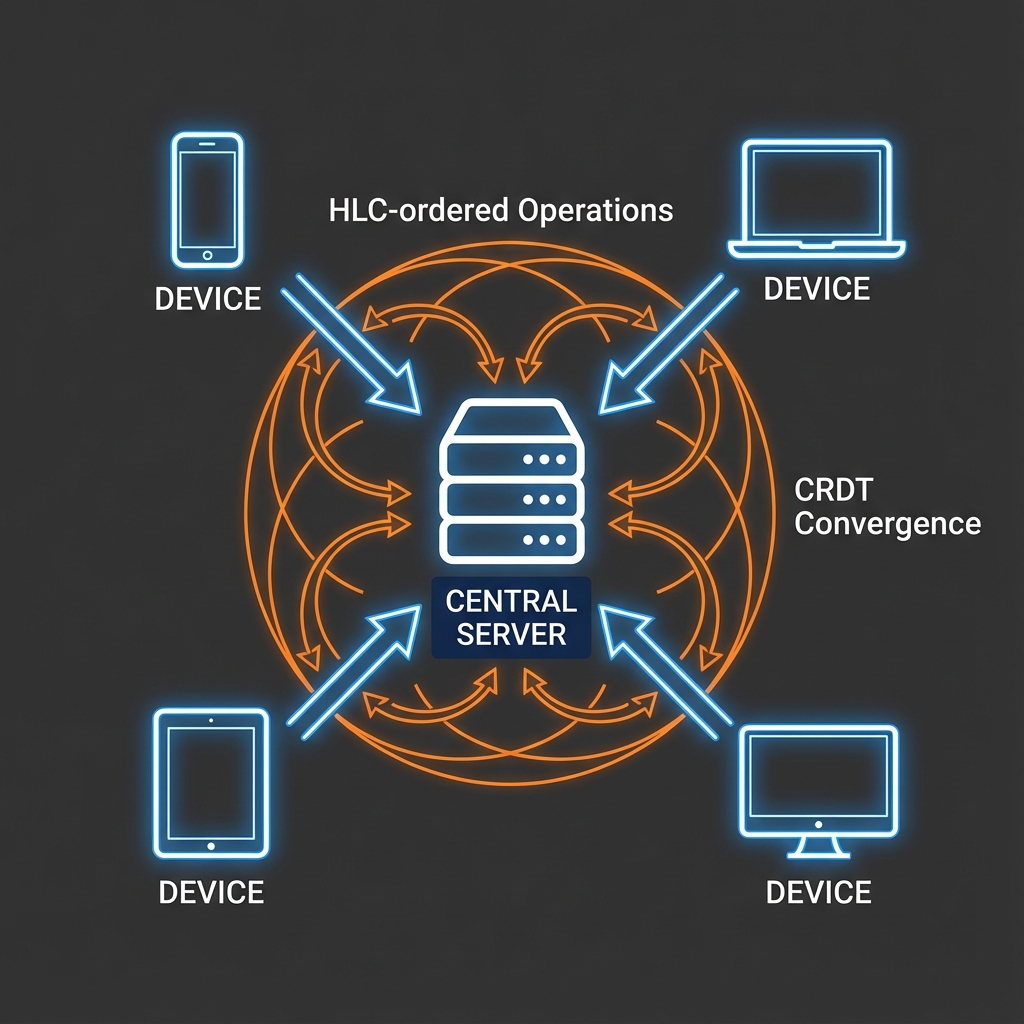
Wall clocks are unreliable in distributed systems. We utilize Hybrid Logical Clocks (HLCs) to establish a consistent causal history for every operation. Your data is anchored in a reliable timeline that remains accurate regardless of clock drift or network latency.
🛡️ Strong Consistency
By leveraging Conflict-free Replicated Data Types (CRDTs) combined with database-level constraints, GanttSync guarantees that all nodes converge to the same state. Simultaneous updates are merged automatically and predictably, every time.
🚀 Scalable Architecture
Designed for horizontal scalability. Our engine uses a distributed message bus to broadcast operations across server clusters instantly, supporting high-throughput synchronization for thousands of concurrent users with minimal overhead.
🧠 Constraint-Aware Logic
More than just a datastore. The engine understands the "physics" of project data, enforcing calendar constraints and dependency chains in real-time. The server validates every operation to ensure the integrity of the overall schedule.
Infrastructure & Security
📦 Single Binary Deployment
A compiled, static binary with no external run-time dependencies. Deploy seamlessly to Docker, Kubernetes, or restricted air-gapped environments.
👻 Low-Latency Protocol
Optimized WebSocket communication ensures that updates are broadcast with sub-millisecond latency, providing a fluid experience for all participants.
🛡️ Multi-Tenant Data Isolation
Security is integrated into the engine's core architecture. Our data isolation model ensures that every tenant environment is strictly partitioned, providing robust privacy and preventing cross-context exposure through deep-layer security primitives.